Vintage Green: The Art of Curating a Personal Cannabis Collection
There is a particular satisfaction that comes from opening a carefully organized cellar—whether it holds a 2015 Barolo, a rare single-malt Scotch, or, increasingly among today's most sophisticated enthusiasts, a thoughtfully curated selection of premium cannabis. The notion that cannabis deserves the same reverence afforded to fine wine or aged spirits is no longer a fringe idea. It is a natural evolution for a culture that has begun to take its botanical pleasures seriously.
At Cannaisseur Brands, we believe that building a personal cannabis collection is among the most rewarding expressions of connoisseurship available today. It demands knowledge, restraint, and a genuine appreciation for the plant's complexity. What follows is a considered guide to doing it well.
Developing a Collecting Philosophy
Every great collection begins with a point of view. Before acquiring a single jar, the discerning collector should ask: What am I drawn to? Some enthusiasts anchor their collections around terpene profiles—seeking out cultivars rich in myrcene for their earthy depth, or linalool-forward expressions for their floral elegance. Others organize by lineage, tracing genetic ancestry the way a wine collector might map regional appellations.
Still others pursue rarity itself—limited-run small-batch releases from boutique cultivators, single-source offerings tied to a specific growing season, or heirloom landrace varieties that represent the plant's unmediated heritage. Whatever the organizing principle, clarity of intention separates a collection from an accumulation.
It is equally worthwhile to establish a geographic sensibility. Just as Burgundy and Napa Valley express themselves differently in the glass, cannabis grown in the sun-drenched valleys of Northern California, the high-altitude gardens of Colorado, or the regulated indoor facilities of Massachusetts each carries its own environmental signature. Collecting across these regions produces a remarkably instructive range of experiences.
Strain Selection: Thinking Beyond the Immediate
The collector's mindset requires a longer view than the average consumer tends to adopt. Rather than selecting a cultivar solely for tonight's enjoyment, the collector considers how a given flower will evolve over weeks or months under proper storage conditions.
Cannabis, like wine, undergoes subtle chemical transformation over time. Freshly cured flower tends to be bright and expressive, its terpenes volatile and forward. With careful aging—measured in months rather than years, and executed under precise conditions—certain cultivars develop a more integrated, rounded character. Harsh edges soften. Complexity emerges. This is not degradation; it is development, provided the storage environment is properly managed.
When selecting strains for a collection intended to be held over time, prioritize cultivars with dense, well-cured structure and robust resin production. High-terpene, high-cannabinoid flower from reputable craft producers tends to age with greater distinction than commodity product. Seek out cultivars with documented lineage and, where possible, establish a relationship with the growers themselves—understanding the harvest conditions and cure duration will inform your expectations considerably.
The Architecture of Proper Storage
No collection survives poor stewardship. The conditions under which cannabis is stored determine whether a prized cultivar flourishes or fades, and the parameters are well established among serious practitioners.
Temperature is the first variable to control. Cannabis degrades most rapidly when exposed to heat, which accelerates the conversion of THC to CBN and volatilizes delicate terpene compounds. The ideal storage temperature falls between 60 and 70 degrees Fahrenheit—cool enough to slow degradation, warm enough to avoid condensation.
Humidity demands equal attention. The cannabis community has largely converged on a relative humidity range of 58 to 62 percent as optimal for long-term preservation. Boveda and Integra Boost packets, sized appropriately for the container volume, are the collector's standard tool for passive humidity regulation. Too dry, and trichomes become brittle and terpenes dissipate. Too moist, and mold becomes a genuine risk.
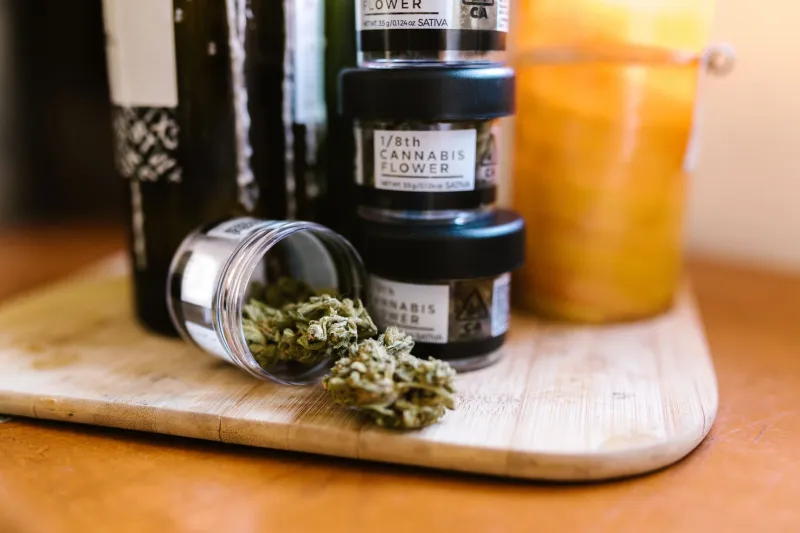
Light exposure is perhaps the most underappreciated threat. Ultraviolet radiation degrades cannabinoids with remarkable efficiency—a fact well documented in the scientific literature. Opaque, UV-resistant glass jars are the preferred vessel. Dark amber or black glass, sealed with airtight lids, provides reliable protection. Mason jars in a lit room are not sufficient for serious collection purposes.
Oxygen management completes the picture. While cannabis requires some oxygen during curing, prolonged exposure to excess oxygen accelerates oxidation and dulls the flower's character. Collectors maintaining significant inventories sometimes employ vacuum-sealed containers or introduce inert gas—food-grade nitrogen or argon—into storage vessels, a technique borrowed directly from serious wine preservation practice.
Organizing and Cataloguing Your Collection
A collection without documentation is simply a stockpile. The true connoisseur maintains records with the same diligence one would expect from a serious wine cellar book or whiskey journal.
At minimum, each acquisition should be logged with the cultivar name, producer, harvest or package date, purchase date, quantity acquired, and the conditions under which it was obtained. More thorough cataloguing includes the genetic lineage, reported terpene and cannabinoid profiles, and the collector's own initial tasting notes upon opening.
Digital tools have made this process considerably more accessible. Applications such as Leafly's review system, or dedicated cannabis journal apps, allow collectors to maintain searchable records across a growing inventory. Some collectors maintain physical journals in the tradition of the wine diary—a tactile practice that many find adds a layer of intentionality to the ritual of opening and assessing a new acquisition.
Labeling containers clearly, including the date first opened, is equally important. Once a jar is introduced to regular oxygen exchange, the clock begins anew, and tracking freshness becomes essential to enjoying the collection at its peak.
The Practice of Tasting Notes
Recording tasting notes is not an affectation—it is the mechanism by which a collection becomes a genuine education. The discipline of articulating what one perceives, in precise and considered language, sharpens sensory awareness over time and builds a personal vocabulary for cannabis appreciation that no external guide can fully provide.
Approach each session with the same structure a sommelier brings to wine evaluation. Begin with appearance: examine the color, trichome density, and structural integrity of the flower. Move to aroma: identify the primary and secondary scent components, noting whether they are fruity, floral, earthy, spicy, or fuel-forward. Consider the aroma's intensity and how it evolves as the flower warms in the hand.
Upon consumption, attend to flavor—the initial impression, the mid-palate development, and the finish. Note the duration and character of the experience. Over time, comparing notes across multiple sessions with the same cultivar, or across different cultivars from the same producer, reveals patterns that deepen both knowledge and appreciation.
Collecting as a Living Practice
The cannabis collection is not a static archive. It is a living practice—one that rewards curiosity, patience, and the willingness to develop taste over time. The collector who returns to a cultivar after sixty days of careful storage and discovers a dimension that was not perceptible at acquisition has experienced something genuinely rare: the pleasure of a collection that teaches.
At Cannaisseur Brands, we hold that cannabis deserves to be met at this level of seriousness. The plant's complexity is more than sufficient to sustain a lifetime of study. The only requirement is the intention to pay attention—and the discipline to store your selections properly while you do.